Showing posts with label Lomax. Show all posts

March 14, 2017

Leadbelly & Babyface & Little David Alexander


Lead Belly: King of the Twelve String Guitar Players of the World

[This article, written by me (Monty Brown), was originally published in the Fall 1996 issue of Sean Killeen’s Lead Belly Letter. It was also published on this blog on 14th October, 2007. Sean Kileen was an ardent fan of Lead Belly and his magazine, (which also can be seen elsewhere on this blog) lived from 1990 to 1996, and reflected his passion. Sean, who hailed from Ithaca, New York, eventually gave up publishing the Letter, partly because there was not a large circulation, but mostly because he was battling for his life. He eventually lost that battle, but his legacy lives on with the back issues of his publication.]

The death of Jesse “Baby Face” Thomas (1911-1995) was reported in the Lead Belly Letter (5,3:2), appropriately, I thought, because of the shared musical heritage of the two men. Lead Belly and Baby Face were two very different characters whose lives, like their nicknames, were often poles apart. The last time their names appeared in such close proximity was in the pages of England’s Melody Maker (12/31/49). There it was reported that Jesse had been “assistant vocalist” to Troy Ferguson in Atlanta in 1929. The death of Lead Belly — Huddie Ledbetter (1889-1949) — was reported in the adjacent column.
I was a friend and a fan of Jesse’s and we spoke many times during the last decade of his very productive life. He was a small, almost frail man, the twelfth of thirteen children born to a sharecropper family in Logansport, Louisiana, thirty miles south of Shreveport. In contrast, Huddie Ledbetter was hefty and muscular, the only child of Wes and Sallie Ledbetter of Mooringsport, Louisiana, twenty miles north of Shreveport.
Huddie played the raucous music of the country house dances, pounding out basic, compelling rhythms, singing, dancing and generally overwhelming his audiences with the power of a one-man minstrel show. He charmed Governor Neff of Texas into a pardon in 1925. He could always charm a gang of children with whimsical words and rhymes recalled from his own childhood. Several people remembered him as being at least six feet tall, though he was only five-seven. Neff was alone in remembering him as a banjo picker; others recalled his ability on the mandolin and church organ. There are recordings of him playing the piano and Cajun accordion in addition to his trademark twelve-string guitar. It’s easy to see how he became a legend in his own time.
Jesse’s instrument was the six-string guitar. He was constantly refining his technique, striving to play in the more sophisticated style of the jazz-oriented musicians of his prime. Though he usually recorded solo, in live performance he was comfortable in the confines of a well-tempered combo. He was an early exponent of the electric guitar and later in life played a double-neck guitar/bass. During his lifetime, Jesse never ceased to be a student of music and the craft of song writing.
Baby Face at 80
Jesse Thomas was a naive fifteen-year-old when, in 1926, he arrived in Shreveport to stay with relatives. He was straight off the family farm. At the same time, Huddie was a bruised and battered thirty-seven, recently released — pardoned — after eight hard years on a Texas prison farm. Like Huddie, Jesse was raised with the guitar. Unlike Huddie, he was surrounded by older siblings who played. His father, Joel, played the fiddle at local house dances. One brother, Willard, was about to land a recording contract with Paramount records under the name Ramblin’ Thomas.
But at fifteen, Jesse became fascinated with the piano, and this is where his life brushed up against the life of Lead Belly. At the time of his arrival in Shreveport, he couldn’t get enough of the piano. He went to movies at the palatial Strand and the other big downtown theaters primarily to hear the players who accompanied the silent pictures.
Did he have any favorite piano players?
“Yeah, there was a guy here named Dave Alexander,” said Jesse in a 1991 interview at his Abbie Street house in Shreveport. “He was good and I wanted to play like him. But I never did play piano like I would’ve like to played, ‘cause I didn’t have a piano to practice on.”
The name of this almost-forgotten piano man reverberated in my mind. Was this “Little” David Alexander who turned up in some lists of old blues recordings? Maybe. It certainly wasn’t the Dave Alexander who recorded for Arhoolie — too young. But there, in an old interview, was Huddie Ledbetter telling about the influence of a piano player named Dave Alexander. Huddie was sure he had incorporated some of Dave’s bass runs into his guitar style, but he couldn’t remember was it Houston or Shreveport? 1906 or 1926?
“I would see (Dave) playing all the time,” said Jessie, who also imitated those piano sounds on his guitar. “He would play in homes where people had pianos. He would visit different places where a piano was. That’s where I heard him playing. Mostly in homes.”
So, he played for house dances — that sort of thing?
“Yeah. And minstrel shows, places like that.”
Did you go to minstrel shows then?
“Oh, yes, it cost ten and fifteen cents and like that to see a good show. The minstrel show would be in a tent going from town to town, traveling. But they’d often pick up a local musician to play piano or maybe some other instruments for them. I played one time in a little minstrel show like that.”
How old was Dave Alexander then?
“Oh, he seemed to be in his twenties. He was a young man in his twenties, I was fifteen.”
This had to be around the same time Huddie had seen him!
Jesse went on, “Dave was pretty popular around here with people at that time. And at that same time those guitar players like Ed Shafers and (Oscar) Woods, they were here but I never did meet them. I’d just hear a lot about them. Never ran across them. And I don’t know where Ledbetter was at that time, either. He probably was in and out of here I guess.”
Jesse never heard Huddie play — he would have remembered — but it’s entirely possible that the two were in the same shotgun house together, enjoying the magic of Dave Alexander. From 1925 to 1930, Huddie was indeed in and out of Shreveport, but not well-known there. He was based some twenty miles north, living in the Caddo Lake area of his youth, working for an oil company and in great demand at Saturday night suppers.
“He was the one they used to follow,” said Liz Choyce, who was in her teens at the time, “Mister Huddie.”
When you say “they used to follow,” you mean his guitar playing?
“People, when they heard tell he was playing somewhere,” she said emphatically, “they would always go.”
“He’d have a crowd. Have a big crowd,” added her husband Leonard. “Awful good music player. When you say you’re going to have a dance there, you’re going to have Ledbetter . . .”
“. . .they’d say ‘Who?’,” Liz cut in, “and you’d say, ‘Huddie.’ Boy! you’d hear them say they were going. Mister Huddie — yes, I knowed him good.”
While Huddie was confining himself to the familiar Texas-Louisiana border country north of Shreveport, young Jesse was striving to get onto record. In Fort Worth he roomed with his big brother Willard. In Dallas he saw successful performers like Blind Lemon Jefferson and Lonnie Johnson. They taught him you could make money with the guitar, so he dropped his dream of being a pianist. Single-mindedly he hitchhiked from place to place — Shreveport to Fort Worth to Houston to San Antonio to Dallas — in pursuit of the portable recording studios. In small towns along the way he bartered music for lodging and a few dollars. Often he took temporary work in the cotton fields. Eventually, persistence paid off: Victor Records sent him a train ticket and he rode from Oklahoma City to Dallas to record four of his own tunes, including Blue Goose Blues.
“Blue Goose?” Jesse smiled a knowing smile. “Oh that’s a little place here in Shreveport, a little area they used to call the Blue Goose. You remember where the Union railway station used to be? Well that was just the name of that area. Like Mooretown, South Highland, Blue Goose. So I just thought of that ‘cause that’s where I stayed when I first came here, and I just — made up some words, put it on record.”
Blue Goose is like Silver City, I thought, the place that Huddie sang about traveling to with Blind Lemon in Dallas back before the Great War. I wondered why Huddie couldn’t have got himself on record just like Jesse did. Here was this green youngster, fresh off the farm and new to the business, getting onto Victor Records at age eighteen. Why not Huddie? The astonishing success of Blind Lemon during the latter part of the 1920’s had encouraged the record companies to scour the Southland for talent. And Huddie certainly had the talent. Plus, he was an old friend of Blind Lemon’s, wasn’t he? Led him around and played duets with him?
Oscar Woods and Ed Shafers got themselves recorded several times during the late ‘20’s and early ‘30’s. They even broke through the color bar on one occasion by providing backup for the white country-bluesman and future Louisiana governor, Jimmie Davis. Ramblin’ Thomas made quite a hit on Paramount and would probably have done much better had he not been addicted to the bottle. None of these performers was superior to Huddie, yet Huddie remained undocumented during this first Golden Age of blues recording. Why?
It’s true he had himself a steady job and maybe couldn’t get away to Dallas, San Antonio or Memphis for a few days, but there was even one recording session in Shreveport in 1928, and there’s no evidence that Huddie tried out for it.
Could it be that he had no wish to leave his safe and friendly environment? He’d been off in the world before and it had brought him much pain. The eight years in a Texas penitentiary, the subsequent estrangement of his first wife, the heartbreaking death of his father, and his commitment to his aging mother, all of these combined may have led him to re-examine his life. He was approaching middle age, perhaps thinking it was time to settle down. Whatever the reasons, Huddie never recorded during the 1920’s when all around him, artists of lesser talent were busy making names for themselves.
This is not to say that Jesse Thomas was a lesser talent. Listen to any of the spate of sides that he recorded in Los Angeles during the late ‘40’s and early ‘50’s and you’ll be delighted with his drive and originality. But Jesse would be the first to admit that he didn’t possess anything like the charisma of Lead Belly. He was Baby Face, a cute little guy who charmed his early audiences with his ingenuousness. He was also known as “Careless Love,” not because of any tendency to womanize, but because he did such an appealing rendition of Lonnie Johnson’s hit recording of that name.
After he told me about Blue Goose, Jesse picked up his guitar and played Blue Goose Blues instrumentally. Even though his hands were often cramped by arthritis in his last five years, he still played with fluidity and distinctness. He finished with a flourish and a laugh.
“Got to get the words down. The music still sounds alright.”
“That’s a good song,” I said.
“Think so?” he laughed. "You know, I didn’t even know what I was talking about at that time. I think I saw some old man and he was real good on the guitar, on the chords. He didn’t sing that good, just play something like that, and I copied some of that and put the words to it. And Blind Blake used to have something kinda in that style. He would play in that style and I thought he was a real good guitar player. Nice chords. Played finger style.”
Jesse picked his guitar a little more and ended by singing the line, “I’m going down to old Blue Goose, got no time to lose.”
That’s it, I thought. Young Baby Face, with the impatience of youth, figured he had no time to lose, so he pursued the recording companies relentlessly. Lead Belly, on the other hand, was patiently biding his time. Which finally arrived.
In 1935, after a further five years of penitentiary time, Lead Belly was given his chance, and his musical career began in earnest. He recorded abundantly through 1948, which was the year Jesse Thomas took up his recording career again, after a nineteen year hiatus. For most of the years Huddie lived in New York, Jesse lived in California. They were both on the West Coast for one of those years, and both of them tried and failed to get into the movies.
Lead Belly returned home to Louisiana in 1949. He was in a coffin. Jesse returned in 1957 and kept on playing for thirty-eight more years. For many of those years he performed with a blind piano player named Peaches, led him around, drove him to and from the gigs. Like Huddie with Blind Lemon. The duo “Jesse and Peaches” was very popular in the Shreveport area. I suspect that Peaches played piano the way Jesse once wished he could.
Lead Belly and Baby Face — poles apart in many ways, yet in some ways quite close. Most of Huddie’s success has been posthumous. Jesse’s success may be bounded by his lifetime. But for those of us who knew him, like for those who knew Huddie, that will be quite sufficient.

December 3, 2016

Chapter 8: Bourgeois Blues (1935 to 1939)

Some people wished they had seen the last of Huddie and Martha Ledbetter. As John Lomax said at the end of the biographical section of his book, Negro Folk Songs as Sung by Leadbelly, "What the future holds for these two Negroes, only time will tell". Huddie wrote to Lomax using an Excelsior Laundry address, in Shreveport, indicating that Martha may have got her old job back. Blues Who's Who refers to this period of Huddie's life, 1935 to 1937, as "working in Shreveport out of the music business" (317). This may well be true.

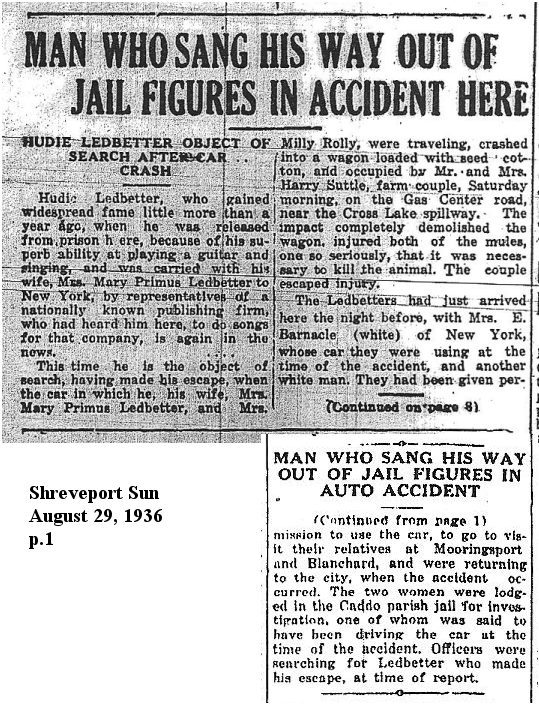
Thanks to Chris Brown (no relation) for guiding me to this article from the Shreveport Sun, a newspaper which still publishes.  One thing it shows is the presence of Elizabeth Barnicle, in Shreveport. It's her car. Also, they've mixed up Mary and Martha, the twins. It was Martha who married Huddie. I wonder if this happened often.


Huey Long
1935 stands out as one of the most eventful years in Louisiana history, but this had little to do with music: Senator Huey P. Long, Louisiana’s all-time favorite politician, was shot down on September 8th in a corridor of the Capitol he was responsible for building. He died in hospital in the early morning of the 10th, ten days after his 42nd birthday. A few months earlier Long had revealed the existence of a plot to kill him, but this would not have surprised anyone. Huey’s popularity came at a cost; he had many wealthy and influential enemies who resented his “Share the Wealth” ideology which advocated a cap on the amount of money a person could accumulate.
  •  To Ross Russell, a jazz writer who owned a record store in Hollywood in the 1940's, Huddie Ledbetter "dropped out of sight" for ten years after leaving John Lomax (Russell 12). Then he turned up in Hollywood. This was very much a West Coast perspective, however. In fact, during those ten years Huddie did a tremendous amount of recording, appeared on many radio programs, and worked clubs and concerts, primarily in the New York area.
According to the Lead Belly Letter, Martha and Huddie returned to New York City at the beginning of 1937. They were with a new agent/manager named John W. Townsend, and were staying with Townsend and his mother at an address in the Bronx. Townsend is referred to as a gas station operator from Dallas.

During the winter of 1936-37, Alan Lomax expanded his folk song collecting to Haiti; he would eventually collect folksongs around the world. From 1936 to 1942 Lomax was "Assistant in Charge" of the Archive of Folk Song of the Library of Congress to which he and his father and numerous collaborators contributed more than ten thousand field recordings. During his lifetime, he collected folk music from the United States, Haiti, the Caribbean, Ireland, Great Britain, Spain, and Italy, assembling a treasure trove of American and international culture.
The elder Lomax (as we have seen) had had enough of his protege, but on 12 June 1937, young Alan brought Huddie to Washington where he supervised some recordings at the Library of Congress. During their visit to the capital, Martha and Huddie encountered an instance of racial discrimination similar to that they had experienced in New York two years earlier, and Huddie wrote about it in one of his most enduring songs, "The Bourgeois Blues." Credit for co-authoring this song is unstintingly given to Alan Lomax.

Me and Martha was standing upstairs, 
I heard a white man say, "Don't want no colored up there,
Lord, it's a bourgeois town 
Ooh, it's a bourgeois town 
I got the bourgeois blues, 
I'm gonna spread the news all around.

Home of the brave, land of the free, 

I don't want to be mistreated by no bourgeoisie, 
Lord, it's a bourgeois town. . . 

The tune for "Bourgeois Blues" is similar to Memphis Minnie's "Dirty Mother For You" of January 1935. It's not difficult to figure out what Minnie means when she sings “He's a dirty mother for you, he don't mean me no good.” Huddie was probably delighted with the unstated reference to Minnie's song himself, but he tended not to be openly raunchy or offensive in his lyrics. About this same time, he was explaining to Alan that "tight like that" was a description of the way people held each other when they danced, while Alan was pretty sure it had something to do with the female anatomy.

There are fourteen titles in these D.C. sessions; these include the blues standard "Hello, Central" and two takes of a topical song, "The Hindenburg Disaster." The explosion of the zeppelin Hindenburg at its mooring, which caused the deaths of thirty-six people, took place on 6th May, 1937, at Lakehurst, New Jersey. "New York City" was also recorded. It's a re-working of a song Huddie had recorded for the American Recording Company two years earlier, a song which was never released during the his lifetime. "Kansas City Papa" is the original, and the refrain,
Kansas City - ain't it a pity?
is changed to
New York City - ain't that a city?

The Kansas City song exudes a completely different attitude to the New York song. Kansas City is viewed from the perspective of a country bumpkin who comes away shaking his head at the strange goings on in the big city. It's an archetypal song; it could've been about Dallas or Shreveport, but it happened to be about Kansas City, which was a mecca for Negro jazz and blues players in the 1920's and 30's. Huddie may never have visited Kansas City at the time he sang the song, though there is hearsay evidence that he visited his ex-wife Elethe there at some point. The verses are folk couplets which may have been used in any number of similar dance tunes. It has all the earmarks of a number played at a country supper.

Funniest thing that I ever did see
Polecat climbing up a 'simmon tree
In Kansas City. . .

The New York song, on the other hand, is specific to that city and
bespeaks a real attraction to, a fascination for, the place.

It's one thing folks I ask you to do
Catch a bus and ride up Fifth Avenue
In New York City. . .

Although the melody and rhythm has not changed, it has become a song for a New York audience.

Pineville, in the coal-veined hills of Kentucky, 1938, is the setting for the recording of three religious songs ("Old Time Religion," "Get on Board," and "Rock of Ages"), which were deposited in the Library of Congress. Huddie is accompanied by his own guitar, by the singing of Martha, and by Jim and Sarah Garland (Dixon & Godrich 384). Pineville is in the Appalachian Mountains near the point where Virginia, Tennessee, and Kentucky meet. The Garlands sang songs and took activist stands on behalf of the coal miners who were attempting to get a better deal from the mine owners at the time. The local law enforcement officers were in the employ of the mine owners, (a common theme in alternative American history), and there were violent clashes between the sides. Jim Garland's mother was Aunt Molly Jackson, also a folksinger and union activist.

Felix Greene in 1968
On October 10th 1938, in New York City, Felix Greene of the British Broadcasting Corporation (BBC) had the foresight to record twelve tracks of Leadbelly: Boll Weevil, I'm Goin' Mother, Go Down Ol' Hannah, Prison Holler, (Baby) Take a Whiff on Me, Irene, Jail-House Blues, Old Reilly, Ox Driver's Song (1), Ox Driver's Song (2), Julie Ann Johnson, Governor O.K. Allen. Because of the alternate take of the Ox Driver's Song, we can assume these were the total recorded.  Even the biography "Legend of Leadbelly" by Charles Wolfe and Kip Lornell doesn't have this session listed and we do not know if they were ever broadcast on BBC's "American Jam Sessions" of 1938. It would have counted as Leadbelly's first radio broadcast, if it had taken place. And on the BBC at that!  

Aunt Molly Jackson
The idea of documentary recordings was just getting underway — some of the late-1938 Library of Congress recordings begin with a dialogue between the "informant" (sounds a bit like a law enforcement term) and the "collector" and end with a song; others continued the informal dialogue throughout the record. As many as seventy-five recordings were made of Aunt Molly Jackson, for instance, and funds for making some of these records available at cost to musicologists and others interested in grassroots music were supplied by the Carnegie Corporation. Leadbelly recorded about 200 sides for the Lomax's Library of Congress collection.

The folk music also reached some 15,000,000 young listeners via [Alan] Lomax's "Well-Springs of America" Series broadcast on Columbia's School of the Air. Begun in 1939, as the series continued it became more and more a survey of a state or an area, and radio listeners began paying tribute to this documentary approach by writing: "I like to listen to the songs about the unknown heroes of labor and the farms," or, regarding programs of Negro songs: "In them one sees courage and a rhythmic dignity." Folk singers are guests and contribute to material used in the script, but Lomax frequently sings too. Though he's mostly known as a collector, he felt he was accomplished enough a performer to entertain the King and Queen of England at the White House in 1939.

A potential Last Straw to the Leadbetter story was added in the late spring of 1939, and a lesser man may have bowed under the burden. On March 5, during a party at a West 52nd Street address, he was arrested, accused by one Henry Burgess of stabbing and slashing him a dozen times. Huddie countered that he did indeed stab Burgess, but only in self-defense, and pled Not Guilty in magistrate's Court. He was freed on bail of $1000 which was posted by Alan Lomax through the National Surety Corporation. On March 13th, the New York City court cabled the Caddo courthouse in Shreveport for Leadbelly's criminal record.

A week later Huddie appeared before a Grand Jury, describing himself as a "musician, song composer, and dancer." The deputy District Attorney, now familiar with the accused's past, asks that he "not be allowed to sing his way out of this one."

That same evening, March 20th, 1939, he played at the Savoy Ballroom on Lenox Avenue in Harlem.

Three days later the Grand Jury indicted him for "assault, second degree, carrying a dangerous weapon after prior conviction." Again, he pled Not Guilty and remained free on bail, pending trial.

On March 26th he performed at the Labor Stage of the International Ladies' Garment Workers Theater on West 39th Street.

Then, on 1 April, 1939, Alan Lomax supervised an important recording session for Musicraft in New York, (Russell 14). Important to Huddie, certainly, because it resulted in the commercial release of a now rare 78 r.p.m. album which included "Frankie and Albert," called by John Lomax, Lead Belly's "Ninth Symphony, [his] small opera with stage directions" (Negro 192). "Fannin Street" and "Bourgeois Blues" were also recorded and released; the public at last had an opportunity to listen to Leadbelly on home phonographs. Important, also, because it took place in the midst of his legal troubles and resulted in what many believe to be the best recordings of his career. He recorded fifteen sides for Musicraft, accompanying himself on guitar and tap dancing. Oh for a filmed version!

The trial took place at the beginning of May, and though the big news in New York concerned the opening of the World's Fair, the Herald Tribune found space for an article on the entertainment page. It included a capsule biography which was the usual mixture of fact and fiction:
In 1930 Lead Belly “stabbed six Negroes in a fight over a can of whiskey” and was sentenced to a ten-year term at Angola . . . . It was there that Dr. John A. Lomax, curator of folk songs for the Library of Congress, "discovered" him. . . .“Once again a song addressed to the state Executive Mansion won a pardon for Lead Belly”. . . . Dr. Lomax arranged a singing tour which lined Leadbelly's pockets and enabled the Negro to marry his lady-love, Martha Promise. ("Lead Belly Adds")
Britain's King George VI graced the cover of Time Magazine for 15 May, 1939, an issue which reported the cementing of the Rome-Berlin Axis (21). The King and Queen of England were embarking on a visit to America which included hearing Alan Lomax sing Leadbelly songs to them at the White House. Leadbelly would have sent his regrets that he could not be there in person because of his legal problems, and there was also a story in that same issue (p76) sketching his progress from the Texas penitentiary, through his incarceration in Angola for "stabbing six negroes in a fight over a can of whiskey," to being pardoned by the State of Louisiana "at Lomax's suggestion." Both claims still not true.
“But last week it was the same old story. Standing in Manhattan General Sessions, greying, 54-year-old Lead Belly once again heard a jury pronounce him guilty. Offense: stabbing and slashing Henry Burgess, another Negro, at a party in a Westside rooming house." ("Lead Belly" p77)

On May 4th he was convicted of assault, third degree; the jury recommended clemency. On May 15th, Judge George L. Donnellan sentenced him to one year, with a recommendation of mercy. His prison sentence began on May 20th and ended after six months on November 20th. Huddie had been on his best behavior at the prison on Riker's Island in New York's East River, and for the last ten years of his life, he never again went to prison.

December 1, 2016

More on Cotton Picking

More About Cotton Picking
With Preston and Mary Brown, next door neighbors to Wes, Sallie, Huddie (Leadbelly) and Elethe Ledbetter.

Question (Monty or Marsha): Did you ever know any of (Huddie Ledbetter's) wives?

Preston: Huddie's wife? Oh, yes ma'm, I knew his wife. The woman he married - he left here, you know, and went to West Texas, and when he come from West Texas, he brought this lady with him. You remember his wife, don't you?
Mary: (No, I don't)
P: Little woman
M: (I never seed her)
P: named Letha. . .
M: I didn't know her. I knew Huddie because he used to come to our school.
P: Named Letha. . . little bitty, I mean she was little, low. I know Queenie's brother, George, he married, Huddie and George was first cousins, and Huddie and him married two sisters, from West Texas. They'd go out there and pick cotton.
Q: That's what they'd do?
P: Yes, Huddie could pick cotton, he made plenty money picking cotton, and so they would go out West and they got going with these girls and he married Eletha, and he brought her here. Farmed right up the road there. . . by Davis's just south of the road, that log house just south of the road.
Q: Did a lot of people do that that were good at picking cotton? They'd go pick in someone else'd plantation?
M: (laughing) Yes, I did. Ooh I used to love to do it.
P: If you were farming, you had cotton, well, people go and pick cotton for you, pay them so much a hundred.
M: I'd pick 200 pounds a day.
[Several voices - P is talking about a truck coming up.]
M: I had a daughter could beat me; I had a son - that one over in Karnack? - he could beat me, I tried my best to beat him, but
Q: And you loved to pick?
P: And they'd bring 'em home and come and get 'em every morning.
Q: Even if you had your own land, you would go pick on someone elses cotton?
P: Oh, yes, you done got your crop gathered
M: Yes, you could pick cotton til January
P: Pick that cotton, man 200 pounds of cotton. You could make you a pack of money in a little while. Cause you could save money then for
M: They weren't paying much money
P: Great big sack be about 35 cents.
Q: What did you like about picking cotton? Cause you could be outside?
M: Mm-hmm, just be outside and be racing with the others -
Q: It's like a contest every day?
M: (warming to her theme) we be racing and trying to beat the others picking cotton, they try to beat me and I try to beat them. I couldn't beat them, I couldn't beat my daughter, though, and I couldn't beat my son (Preston is trying to say something about chopping with a hoe) when they start pulling, they could pull over 200 pounds a day, pulling that cotton. I start staying at home then.
Q: What do you mean by pulling?
M: Just take the cotton and come on up.
Q: The whole branch.
M: Some of them got the stalk and all. Unless it's done rotten,
the cotton done rotted.
Q: But sometimes when you're picking, do you just pick the white cotton part?
M: (Yes) Just the white cotton part.
Q: That's picking! But when you're pulling, you're pulling up the whole plant.
(Preston is talking to Monty throughout)
M: When you're pulling, you catch onto that stalk, and come on up. . .all that cotton into your hand. Bolls and all.
P: . . .long way from that gin, and the cotton going another place(?)
M: We had so much fun, that's one thing I liked, we had so much fun. In the field, laughing and talking, but we would be working.
P: Yes, I sure did like it. Them boys down, there. . .playing around. . .picking 200 pounds of cotton.
M: Yes, I had a nephew could do that, he was about 17, he wasn't 17, about 16 years old, he'd run all over the field and play and play and play, but when he come to the scales, he had 200 pounds of cotton.
Q: So, he had a good time and he was still fast? (yes) Did some people have a good reputation, be proud because they were the best cotton pickers?
M: (laughs) I didn't call myself a good cotton picker, but I could keep up with the rest of them. Sometime there be 4 or 5 of us together and we just be hanging(?) and hanging but one lady, I just didn't like for her to pick beside of me because she'd strip my row just like she'd strip her row, and she was nagging so bad, and I didn't like for her to pick 'side of me. She was older, but she sure could pick cotton.
Q: So, she'd reach over into yours, too?
M: Oh, she'd get off of her row over there in my row. I'd be carrying two rows.
P: Woman could pick cotton, too, couldn't she.
Q: Did you ever get into any fights in the cotton field?
M: No. We didn't get into no fights. Everybody got along good.
P: Nothing but them damn bolls, that's what they're doing. Picking cotton, that's what they were fighting. Fighting them cotton stalks.
M: I chopped cotton, too. I chopped cotton and I picked cotton.
P: (talks about the mechanical cotton pickers). . .that knocked out our whole life.

M: They not only had cotton pickers, they had geese down there, picking the grass. We didn't have to chop cotton sometimes on it.
Q: They had geese?
M: Geese. They had a bunch of geese, they bring them down and turn them loose.
P: (in background) bunch of geese to keep the grass out of the cotton.
M: Sure would clean it too.
P: (Talks about turning the geese out into the field) Save the man 2, 3 dollars a day chopping cotton.
Q: Where did you go fishing? Did you go to the (Caddo) lake to fish?
P: Yes.
Q: Did you have a boat?
P: Oh yes.
M: That's one thing I never learned to do. I never liked to fish, but I love to eat them. I played in the water, but my mother would talk about whipping me and then I had to stop. (Laughter)
Q: So, you used to live on the land where the Ammunition Plant is now? (yes). They bought your family lands?
M: They give us what they wanted us to have, and so many days to move out of the house.
P: All that land used to be nothing but farms. There's a million(?) acres tied up in that plant, wasn't nothing but farms. No trees, nothing on it. People farming.


November 22, 2016

Boll Weevil, Boll Weevil

The Boll Weevil in life and song.

All was not totally sunny in the Cotton Kingdom in those days, as the century drew to a close. The dark cloud on the horizon was a little bug called the Mexican boll weevil.


Shortly after the turn of the century, the boll weevil arrived to wreak havoc on the cotton crops. In 1904 the Texas legislature offered a $50,000 reward to anyone who could solve the boll weevil problem which was costing cotton farmers $50 million in that year alone. Mexican boll weevils, by far the most destructive insects to attack cotton plants in the United States, were first found north of the Rio Grande around Brownsville, Texas, in 1892. Seemingly unstoppable, they kept inching northwards. They made it as far as Caddo Lake in 1904 and kept spreading north and east. They reached the Atlantic coast (Georgia, the Carolinas) by the 1920s.


Many variations of boll weevil ballads spread throughout the cotton kingdom, but most of them featured the farmer being tormented by a cartoonish weevil. In legend and song, the farmer was entirely at the mercy of this pest; his frustration comes out in the song of the charming little bug who's "just looking for a home:"     


Some Typical lyrics:

The boll weevil is a little bug, come from Mexico, they say,
He come to try this Texas soil, thought he'd better stay.

Farmer took the boll weevil, he put him in the ice

Weevil said to the farmer "It's mighty cool and nice."

Farmer took the boll weevil, buried him in hot sand -

Weevil said to the farmer, "I'll stand it like a man."

Weevil said to the farmer, "You'd better leave me alone, 

I ate up all your cotton, now I'm starting on your corn."


Shreveport in Leadbelly's Youth

Fannin Street & the Bottoms


Shreveport was the big town, "the city," and young Huddie Ledbetter, the country boy, found it totally fascinating. He had seen the State Fair parade down Texas Street; the country wagons gathered to sell their produce on Commerce Street; the white folk in their finery, entering the hotels on Market and Spring; and he'd heard of the night life on Fannin Street.


The 900 block of Fannin Street was the leading edge of Shreveport's legal red light district which had been set up by the city fathers in 1903. Things had been getting out of control, it seems, so the area known as St. Paul's Bottoms was set aside to contain prostitution, gambling and other forms of vice. The idea of having a red light district was not original to Shreveport; it was already being tried out in Memphis, Little Rock and New Orleans. 


During the early 1900's, the Storyville section of New Orleans was a booming, legal, red light district and the legendary birthplace of jazz. Its "sporting" houses served as a magnet for gamblers, pimps, prostitutes, as well as musicians and all manner of performing artists. Likewise, though on a smaller scale, the legal red light district of Shreveport became a magnet for similar folk in the Ark-La-Tex. The district was called a "bottoms" because it was a low-lying area near the Red River; during the sultry summer months there were fewer breezes and more mosquitoes than on higher ground. 

The Bottoms, therefore, was home to a poorer class of people, generally blacks. When it was designated as the red light district, property values soared, existing large houses were rented to madams, and new houses were built. The 900 block of Fannin Street was the priciest part of the new Bottoms, mostly because it was the closest to central Shreveport; it was home to the three biggest sporting houses, those run by Annie McCune, Bea Haywood and Nell Jester. These were houses of white prostitutes for the use of white men. Further into the Bottoms, there were houses of black prostitutes for white men, and black prostitutes for black men; generally the houses got cheaper and seedier all the way back to the railroad tracks. The large "white" houses on Fannin Street did not hire musicians, black or white; they had coin-operated player pianos which entertained clients in the downstairs waiting rooms. 
There were two large Saloons which catered to blacks right on the corner of Fannin and Beauregard which was virtually the gateway to the district. A third large saloon, the White Pigeon, looked over the railroad tracks at the north end of Beauregard. The Pigeon was owned by a white man; it catered to both black and white customers, each race having a separate entrance. The Fannin Street saloons were owned by and operated for blacks, one by George Neil, the other by Caesar DeBose.

Neil was a light-skinned negro who could have passed for white. However, that was not a safe thing to do in that obsessively color-conscious society. George W. Moxley, a light-skinned negro minstrel performer wrote to W.C. Handy about this very subject:
“I worked with several ofay [white] outfits in my time without any trouble. W.A. Mahara was the only minstrel company I traveled with, but I put on an Elks' Minstrel once in Shreveport; they would have hung me in Shreveport had they known that I was colored, and the same is true in plenty of other places.” (From Handy's auto-bio.)

Saloon proprietor George Neil had enough to contend with without trying to pass for white. The walls of his long, one-story frame building which housed a dance hall, stage, bar and restaurant, as well as a couple of gambling rooms, were reputed to be peppered with bullet holes. The Times of Shreveport  reported that police had been openly assaulted by the clientele at Neil's, and "more than one Negro has been taken out, penetrated by a policeman's bullet."


It was a colorful enough place for the police chief to take a group of visting newspapermen for a night on the town. The chief sent word to Neil that he was bringing some out-of-town dignitaries, and Neil arranged a special show of hot ragtime music and specialty dancers. Pairs of dancers emerged in turn from the cakewalking crowd to put on a special "stunt" for the visitors. There were breakdowns, double shuffles, buck-and-wings and many more that the chief couldn't identify. 
When two slender well-dressed couples started the show, the other dancers stopped and crowded around to watch, cheering, clapping and urging them on like testifiers at a backwoods prayer meeting. The first couples were young and supple, and "moved with the grace of leopards." As they finished, the music changed and a completely different pair moved into the limelight. 


The man was undersized and coal-black. He was shovel-footed, buck-kneed and agile as a cat. The woman was chocolate-colored, broad, rather squat, bulged high in front and low behind, sort of shed-room-rumped effect, and badly pigeon toed. They faced each other and danced, turning 'round slowly, his huge foot slapping the floor with loud thwacks and her feet keeping time with a sort of forward and drag back movement. (from "Shreveport Madam.") 
The newspapermen were clearly impressed with the action in Neil's Saloon. There were can-can dancers whose act rivalled the well-known Moulin Rouge in Paris, though the Shreveport version was "perhaps more revealing;" and a hootchie-cootchie girl who performed a Little Egypt belly dance with sensuous abandon. The police chief noted in his memoirs that "her pelvis must have been hung on ball bearings." 


Across the street from Neil's, next door to a Chinese restaurant, was the two-story frame building which housed Caesar DeBose's ground floor saloon. A stairway lead up from the rear of the saloon to a dark, unpainted hallway; off the hallway were doors leading to individual rooms. One upstairs room was set aside for high stakes gamblers, and the rest were for prostitutes. One day in 1908, a federal agent tracked down a notorious counterfeiter all the way from Florida to the gambling room at DeBose's saloon. In the middle of a game, the agent crept along the hallway, stealthily approached the door, drew his pistol and blasted the lock to smithereens.
In the pandemonium that followed, the counterfeiter leapt out of the window onto the roof of the Chinese restaurant and from there to the wooden awning on DeBose's building. He appeared to be heading for the telephone pole to slide down when the awning collapsed under his weight, settling slowly to the sidewalk like an elevator, permitting the fleeing man to escape down the street. 
Caesar DeBose was standing in front of his place, proudly surveying the busy street scene, when the awning came down and, with a tumult of crashing and creaking, knocked the cigar right out of his mouth. As the fugitive tore down Beauregard Street into the dark heart of the Bottoms, the terrified DeBose took off running in the other direction. The saloons run by Neil and DeBose are the places that Huddie Ledbetter may have known in his youth, where he met a coal black piano man named Chee Dee and learned to "boogie the blues." 

November 20, 2016

Oscar Woods

Oscar Woods seemed to have spent most of his working life in Shreveport, a cotton port for much of the 19th Century. The surrounding Parishes, Caddo, Bossier, DeSoto, etc. were major producers. After oil was discovered in the area, the major industry shifted in that direction.
Woods was born in Natchitoches, La. in 1906. Whether in town or out in  the parish remains a question. When did he leave for Shreveport, the big city seventy miles north? He was recorded several times between 1931 and 1940, but he's hard to track down after that. He appears in a couple of Shreveport city directories circa 1950, but I have little knowledge of him through the musicians I've spoken to. The exception, Snook Jones, knew him through the local music scene.
He was recorded by John Lomax in 1940 for the Library of Congress, and this is when he gave up a bit of biographical info. But Lomax didn't seem all that interested in him and you can tell by the singing tone of Woods that he's not going to be a font of information unless there's a show of interest from the interviewer. Information I gleaned from Ausie Grigg, a white cotton farmer from Bienville Parish who recorded with the Grigg family band, was that Oscar participated in a bit of recording history back in the early 1930's. He was recorded in multi-racial sessions in Charlotte and  Dallas, accompanying the Louisiana singing politician Jimmie Davis on several sides. In my opinion, the Oscar Woods material was better than the JD stuff, but that's just me. Also playing guitar on the sessions, was Eddie Schaffer.


Artist Biography by 


Oscar "Buddy" Woods was a Louisiana street musician known as "The Lone Wolf" and a pioneer in the style of lap steel, bottleneck blues slide guitar; some experts believe he may have been the primary force behind the creation of this whole genre. Woods was born in the area around Natchitoches, LA, and his unknown birth date is variously listed as having been anywhere from 1892 to 1900. About 1925 he is known to have re-settled in Shreveport, LA, working as a musician and "street-rustler." (In England he would be known as a "Busker.") It is said (Who said?) that Woods developed his bottleneck slide approach to playing blues guitar after seeing a touring Hawaiian troupe of musical entertainers in the early '20s. 
Not long after arriving in Shreveport, Woods began a long association with guitarist Ed Schaffer, and together they performed as the Shreveport Home Wreckers, often appearing at The Blue Goose Grocery and Market, a notorious (?) Shreveport establishment said to be an after-hours speakeasy. Woods and Schaffer made their first two recordings as the Shreveport Home Wreckers for Victor in Memphis on May 31, 1930. For someone whose handle was "The Lone Wolf," Woods was extraordinarily lucky in terms of the number of recording dates he was able to secure in connection with other artists. From this first session up until his last, a field recording for the Library of Congress made on October 8, 1940, Woods was involved in the making of no less than 35 sides. 
Jimmie Davis, former Governor of Louisiana, said: "I remember one time I went to record (for Ralph Peer and Victor) and they had the old Carter Family there — A.P.,
Sara, that's his wife, and they had Mother Maybelle, and they recorded there. We played a theater every night — Buddy Jones, that's the boy that played with me . . ."

Q: Dallas?

JD: No, this was in Charlotte, North Carolina. That's where they picked up Jimmie Rodgers.

Q:  I was gonna say, did you ever run across Jimmie Rodgers?

JD: Yes, I met him. We recorded the same day one time. He was about through his recording. He recorded eight sides the day he died. (Rodgers died on May 26th, 1933, in New York City where he was recording for RCA Victor.)

On May 27 and 28, 1931, Ed Schaffer was in Charlotte, NC, recording six sides headed by white country artist (and future Governor of Louisiana) Jimmie Davis along with New Orleans-based jazz guitarist Ed "Snoozer" Quinn. Nearly a year later in Dallas, TX (on February 8, 1932) Davis made four sides with the Shreveport Home Wreckers (and Ausie Grigg on bass) as accompanists, and then the Home Wreckers made another pair of sides on their own, issued this time on Victor as by "Eddie and Oscar." These sides are of key sociological importance as they are the first known Southern-made records of country blues made by a "mixed race" group. Needless to say, Victor did not go out of their way to publicize this aspect upon the initial release of these sides, which occurred during the worst year in the history of the record market. However, some old timers (who?) recalled that the association between Jimmie Davis and the Shreveport Home Wreckers didn't just end at the recording studio door -- amazingly, they also toured together. 
Oscar "Buddy" Woods did not record again until he made a trip to New Orleans to make some solo records for Decca on March 21, 1936. One of these recordings was of Woods' signature tune, "Lone Wolf Blues," and another his first recording of "Don't Sell It, Don't Give It Away." These did so well in the race record market that Jimmie Davis took a renewed interest in the Shreveport Home Wreckers. By the time Woods returned to record in a session set up by Davis in San Antonio on October 30-31, 1937, the lowly two-man Home Wreckers had expanded into a six- or seven-piece string band called the Wampus Cats. The Wampus Cats also included a female vocalist by the name of Kitty Gray, guitarist Joe Harris, and mandolinist Kid West. The Wampus Cats made an additional session in Dallas on December 4, 1938, on which Kitty Gray does not appear, but unknown trumpet and saxophone players are therein added to the mix. 
After Oscar "Buddy" Woods cut his last five selections for the Library of Congress in 1940, he disappeared from public notice until his death in 1956. On the same date as WoodsWampus Cats alumni Joe Harris and Kid West also recorded 11 pieces for the Library of Congress as a duo. As in the case of Woods, they were never heard from again. Ed Schaffer is even more obscure than his compatriots, and may have died even before the San Antonio sessions with the Wampus Cats, as he is not known to have been present on that occasion. According to entries in Shreveport city directories, Woods stayed in the Shreveport area in his final years, playing dances and working as a street musician. 
The impact of Oscar "Buddy" Woods on the development of bottleneck slide playing was crucial; one musician he took under his wing around 1930 was Texas native Babe Kyro Lemon Turner, who later assumed the name Black Ace. During his lifetime, Woods was best-known for "Lone Wolf Blues," but today the most often anthologized cut in which he was involved is the Wampus Cats' version of "Don't Sell It,-Don't Give It Away." Also, bluesman Robert Johnson paid the Shreveport Home Wreckers an offhand tribute by lifting one verse practically verbatim out of their 1932 "Flying Crow Blues" and using it as the concluding verse in his own "Love in Vain."

December 12, 2015

Alan Lomax. In his own words.

Alan Lomax is interviewed about Huddie Ledbetter, and about the Folk song Archive at the Library of Congress. When Alan first met Leadbelly, in the early 1930's, he was 17 years old and helping his father John Lomax collect songs and tunes in the Deep South.

December 10, 2015

Lomax - Leadbelly Interview: 1940

Interview with Huddie, recorded by Library of Congress folklorist Alan Lomax in Washington, D.C. in 1940. Huddie talks about a sukey jump, circa 1900. The conversation is recorded onto discs which contain perhaps three or four minutes each, and are spinning around at 78 revolutions per minute. There is no time for long pauses or considered answers. While the interview sounds a bit like a word association game, it does gives an impression of what the dances were like. Lomax opens the conversation.

I want Huddie to tell you about the way they put on the square dances down in Louisiana when he was a boy, growing up, in the backwoods. 

[Specifically, he's asking about the Caddo Lake region near Karnack, TX, and Mooringsport, LA. Harrison County, on the Texas side, was dry, while Caddo Parish, the Louisiana side, allowed alcohol sales.] Huddie, what did they call square dances?
Ledbetter: Called them sukey jumps.

Why did they call them sukey jumps?
Ledbetter: Well, because they danced so fast, the music was so fast, and the people had to jump, so they always called them sukey jumps. (It looks to me like Leadbelly is just improvising through here. He was always pretty fast with a comeback.)

Do you know what "sukey" means?
Ledbetter: Sukey - well, that's a cow sometimes when you tell her, "Sukey, sukey, sukey," you know, keeping the cow away.

Did they ever holler that at the dances when they had them?
Ledbetter: They'd just holler "Sukey jump!" and they'd holler, "One dollar bill, baby, won't buy you no shoes," just anything they feel like singing in there.

What kind of music did they have? 
Ledbetter: Well, they had a fiddler in them times; and accordions.

And what were the names of some of the tunes they played?
Ledbetter: The tunes was "Poor Howard," he was a poor boy and he played the fiddle. He was the first fiddler after the negroes got free from slavery time. Poor Howard was a negro used to play for them at the sukey jumps. And the number he played was "Poor Howard, Poor Boy."

How does that go?
Ledbetter: [Plays and sings.] "Poor Howard, Poor Boy" goes like this. 

Huddie, did they call the sets [as in square dance calls] at these dances?
Ledbetter: They called the sets all the time when they danced; they called "Shoo-fly," you could shoo-fly, and the square dance.


How did that sound? Give us a sketch of how they called the sets down there.
Ledbetter: When they called the sets, they holler, 
"Hey, man, you swing mine and I'll swing yours," 
but when they first get on the floor, they holler, 
"Grab your partners, step the right way round," 
they always drive right way, 
"Now, man, you know you're going wrong, 
now circle left way round, 
and when you get back to your home, 
grab your partner, 
the first man on the head, shoo-fly.
"When you get the shoo-fly, then they holler,
"Shoo-fly, Shoofly" 
then they come to the holler,
"One dollar bill baby won't buy you no shoes." 
[Huddie goes on singing and playing, calling the set "One dollar bill. . ."]

Huddie, did they have any real fast numbers at these dances? Do you remember any of those?
Ledbetter: They'd pick 'em up. 

When they'd do the hoedown and. . .
Ledbetter: They'd pick 'em up, you know, they'd have some fast ones when they'd just go, like, "Green Corn, Come Along Charlie," "Gonna Dig a Hole to Put the Devil In," and, "Tight Like That," sometimes they'd holler, say, "Tight like this!"
[They are both talking at once through here.]

What did they mean by that Huddie, really? I mean, tell us confidentially what they meant by "tight like that."
[Lomax may have been fishing for some sexual innuendo, but Huddie wasn’t playing along, perhaps realizing there was nothing "confidential" about this interview.]

Ledbetter: "Tight like that" means when you got your partner, grab and hug her tight, and keep her going, but when it comes time the boy grab his partner, he grab her and giving her a hug, he says, "Tight like this, it was tight like this, but now it's tight like this." And the boys'd be jumping on "Tight like that."

What were some of the dance steps, Huddie, when they were playing some of these fast tunes?

Ledbetter: Well, ain't no dance steps you could do but "breakdown," and that's a fast number. You can't dance no tap dance, I don't think, a fast breakdown number, course you might, but that's where all the tap dances [Huddie is talking very fast, as though he's afraid of being interrupted] . . . all the tap dances come from the old "buck and wing" what they used to do. Well, the breakdown dance, nobody do 'em now, but I don't guess nobody know nothing about it very much, but me, and I do the breakdown. When you do it you got to do it real fast, and when you breakdown you ain't tapping, you just working your legs. Now, a long time ago my grandfather, great-grandfather, say, "you ain't dancing til you cross your legs." So I guess now, nobody dancing because they don't cross their legs hardly ever. But when you do that old breakdown, and wing down, and green corn and that old ground shovel and, uh . . .

What about "knocking the pigeon wing?"
Ledbetter: . . . pigeon wing and . . .

. . . cutting the back step?
Ledbetter: . . . cutting the short dog, well, you got to cross your legs.

Huddie, play us one of those tunes, something like "Gonna Dig a Hole to Put the Devil In," and tell us what it means, too, you know. 
Ledbetter: "Gonna Dig a Hole to Put the Devil In" - long years ago, that was when they see the boss coming, you know? And the boys would see the boss coming, well, they didn't like him, you know, but they'd be together, nothing but negroes all piled up there together. When they'd see him coming, they'd say, "Well, we're gonna dig a hole to put the devil in," boy they'd start a-jumping. [plays "Gonna dig a hole. . ." with very fast accompaniment on guitar.]

Huddie, can you play "Green Corn" on the twelve-string guitar?
Ledbetter: I think I can. 

Let's hear a little of "Green Corn." [Huddie starts to strum his guitar. Lomax interrupts] Slow and easy and sweet, Huddie! [Huddie slows the tempo] What is green corn, anyhow? Tell us about it when you sing the song.
Ledbetter: [Strumming and explaining] Now, this is a fast sukey jump too, but the boys take it easy sometimes when they want to sukey jump; keep them dancing so hard and take it easy on the ground, shuffle around with your partner, [sings, but doesn't explain "green corn". Lomax tries to interrupt with "What is green corn?" but Huddie either doesn't hear, or ignores him. Then, just as the song ends] What is green corn? What is green corn, Huddie? [Lomax likely wants to hear that green corn is some form of white lightning, but, again, Huddie is not co-operating. He keeps it simple.] 

Ledbetter: Green corn is an ear of corn - when it's green. What they mean by green corn, they're just putting that in the words, you know, 'cause the man is green and they didn't know what they was talking about themselves. What they was speaking about is an ear of corn when it's green. Down south when the corn gets dry, why then that's corn - hard corn, then. But when they say "green corn", that means it's green, you can go out in the field and pull it and roast it. . .

I thought you meant green corn whiskey. (I agree with Lomax in thinking Green Corn refers to whiskey. Huddie is often just very contrary and it's hard to believe that songs would be sung about ears of corn.)

Ledbetter: No, not no green corn whiskey, they didn't know nothing about no corn liquor at that time. They had old-time liquor, you know, that's real good liquor, wasn't no bootleggers then. Couldn't make no liquor. How are they going to make liquor when they're all slaves? [Huddie sounds condescending] The old boss — they wouldn't get no liquor till the boss would give it to them.

Huddie, at these old-timey sukey jumps, did people dance in their bare feet, or with shoes on?
Ledbetter: Well, them that could get shoes, they would dance like that and lots of them didn't have — 'cause I know plenty boys in my time —

[interrupting] . . .what about the women? Would they wear shoes or not?
Ledbetter: Well, when they could get them. If they couldn't, they just go barefooted. 

Would they ever circle left in these dances, or
Ledbetter: They's circle left right, they'd start out right. . .

 . . .they'd start right first?
Ledbetter: That's right. . .

[talking on top of Huddie] How many times would they go around right?
Ledbetter: Well, you see, when they'd first start right, they'd go around right and then the man would holler, "Circle left way round,"

And they'd gone one time around?
Later Lomax
Ledbetter: That's right and then he'd holler, "Circle right way around again, and when you get back home, grab your partner," so when they first start out circling right way around he'd tell them to skip on up ahead and catch the next partner in front of them, and they'd keep on catching and he'd say, "Now, when you get home, circle left way around" and when they get home, they circle left way around, he says, "Now circle right way around, and when you get back to the spot, settle down. First man on the head, grab his partner and shoo-fly." That's the way they do that down there. (Library of Congress)

What's in a Name?

What's In a Name? The Strange Case of David Alexander In the late 1980's I was doing my radio show, Louisiana Folk Music and I pl...